Political History
Created by Meredith Lorenz for PoliSci 318 at Davidson College
In 1930, Florida had five congressional districts and seven electoral votes; it was strongly democratic but held little national influence. Over the years, the state attracted retirees, young families, and a large population of immigrants. With these population gains, Florida came from modest beginnings to be the most influential state in the 2000 election, and continues to influence national politics. Likewise, Florida’s internal politics have continued to shift with population shifts.
Population shifts have proved politically volatile. As pollster Geoff Garin noted, “people on the voter rolls today weren’t on the voter rolls five years ago. [. . . ] Florida politics are much more related to the tides of events and personalities” (National Journal 2004). Until the 1980s, retirees flocked to Florida; in the 1980s-90s, the booming economy attracted young couples and families. Meanwhile, immigrants, particularly Latin America, came to Miami, the “economic and commercial capital of Latin America.” Not surprisingly, most of the financial wealth of the population was not earned in Florida, but brought to Florida to avoid income and inheritance tax (National Journal 2004). The divided population has caused Florida politics to depend heavily on district lines and middle ground politics.
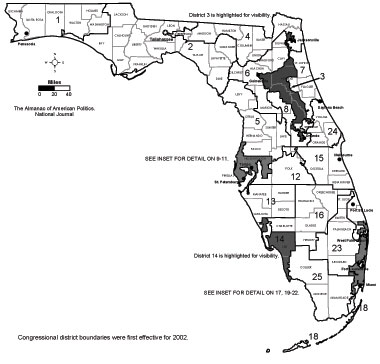
Despite Democratic majority in the early 1990s, disagreement over redistricting in 1992 led to federal court rulings in 1992 and 1996, which apparently favored Republicans. After the 1994 election, Republicans held a 15-8 majority in the House (National Journal-Districting 2004) and then won “the state Senate in 1996, and the governorship in 1998” (National Journal 2004). These gains led to the highly lucrative, Republican-controlled redistricting of 2002.
However, the state remained divided on the presidential level, with Bush winning 48.85% of the vote over Al Gore’s 48.84% in the 2000 presidential election (National Journal 2004). Shortly thereafter, Jeb Bush managed to win the governorship in the 2002 election.
Apparently moderate politics is the remaining stronghold for the Democrats who must juggle the highly volatile population. The remaining Democratic offices have been held by candidates who followed a pattern: “all little-known legislators from conservative middle-sized counties . . . with moderate records who ran for statewide offices . . . and . . . beat a more liberal candidate in the runoff” (National Journal 2004).
Interestingly, the elderly population in Florida seem more dedicated to party loyalties than government benefits. In elderly districts, “Republican congressmen . . . who have supported changes in the Social Security system have been reelected in all but one case by wide margins” (National Journal 2004). This population shows little shift based on typically “elderly” issues.
Meanwhile, environmental issues have gained importance: despite attempted development in the Everglades during the 1800s, immigrants and retirees now seem concerned with preserving the beauty of Florida. In 1996 “voters approved an amendment for cleaning up the Everglades. Then both parties came together [to restore] the Everglades” (National Journal 2004). The importance of environmental issues has continued to increase.
Created: 9/10/2004. Updated: 9/10/2004.